Making Lowe's Product Info Instantly Available and Trustworthy
Conversation Design · Product Writing · Self Service Flows
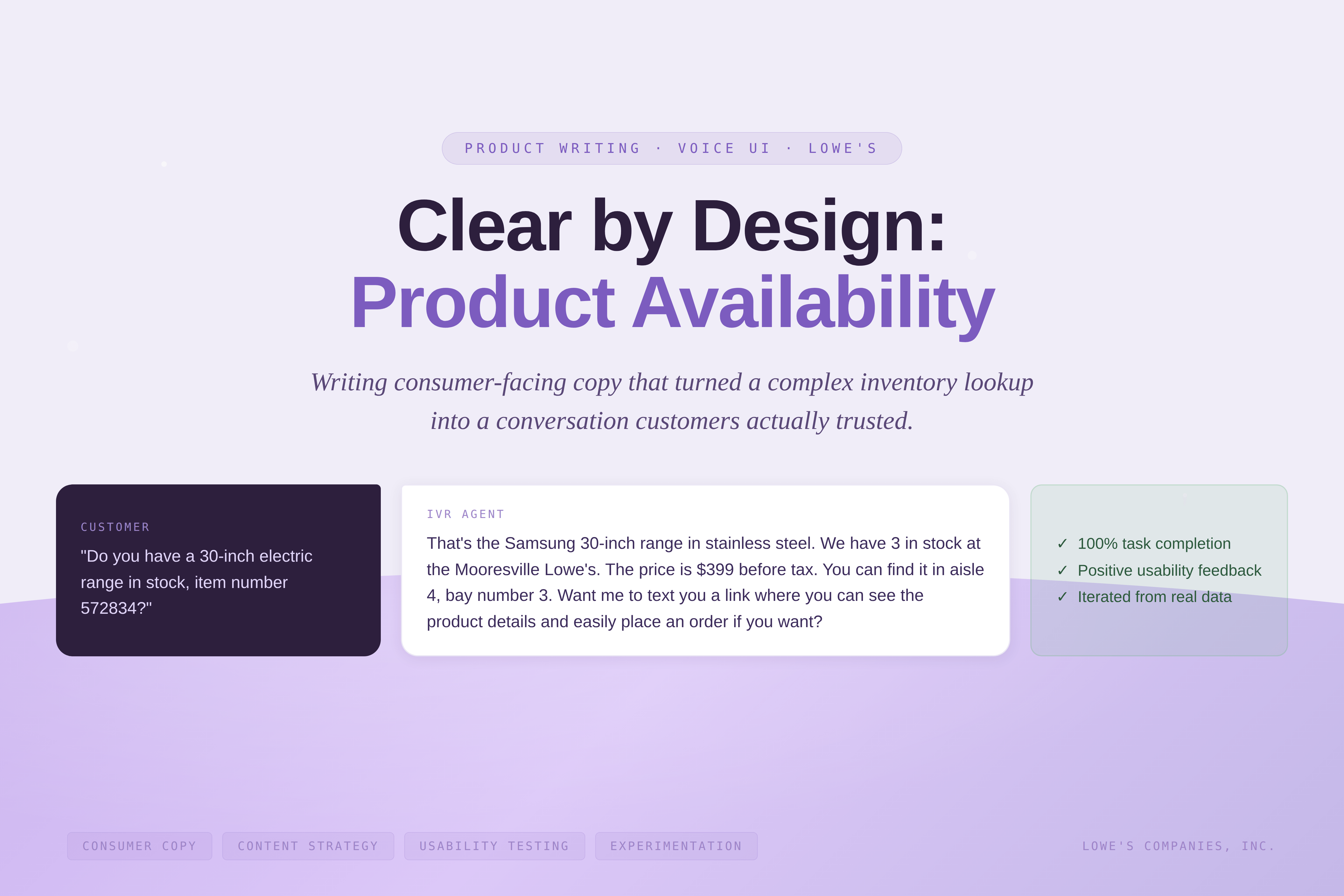
I led conversation design and product writing to help Lowe's store callers get real-time product availability by crafting clear, confident copy that gave customers real-time answers without needing to speak to a human.
Role
Conversation designer and content strategist
Partners
Product design, product management, engineering, store ops
Focus
Product writing, content strategy, conversation design, flow logic, usability testing
The Challenge
Lowe's customers call stores to see if certain products are stocked in the store so they don't waste their time driving to the store to check. Store associates are often busy helping the customers in front of them and can't answer the phone and search for products in the store.
The Opportunity
If the Interactive Voice Response (IVR) phone system could provide customers with product availability information, then the customers would quickly get the information they need, saving both customers and associates time.
The Approach
I worked with another designer and our product manager (PM) and developer team to create a product availability experience in the IVR to address the customer's needs.
Ideate
We created call scripts to visualize the ideal experience. We studied how real customers talked about product availability and used their natural language to shape the copy. We wrote prompts that matched how people actually asked questions, not how a system expected them to.
Constraints
We worked with our developer team to understand our API capabilities:
- If given an item number, an API that would return an item's full name, in stock status, and quantity.
- If given an item description, an API would return a link to all the products that were in stock at a specific store that matched that description.
Iteration
Using this information, we refined the conversation. We wrote specific prompts for all possible stock statuses and developed two paths, one for customers to provide an item number and one for them to provide a description.
We engaged our developer team, PM team, and business stakeholders to finalize the design and ensure we were covering as many valid edge cases as possible.
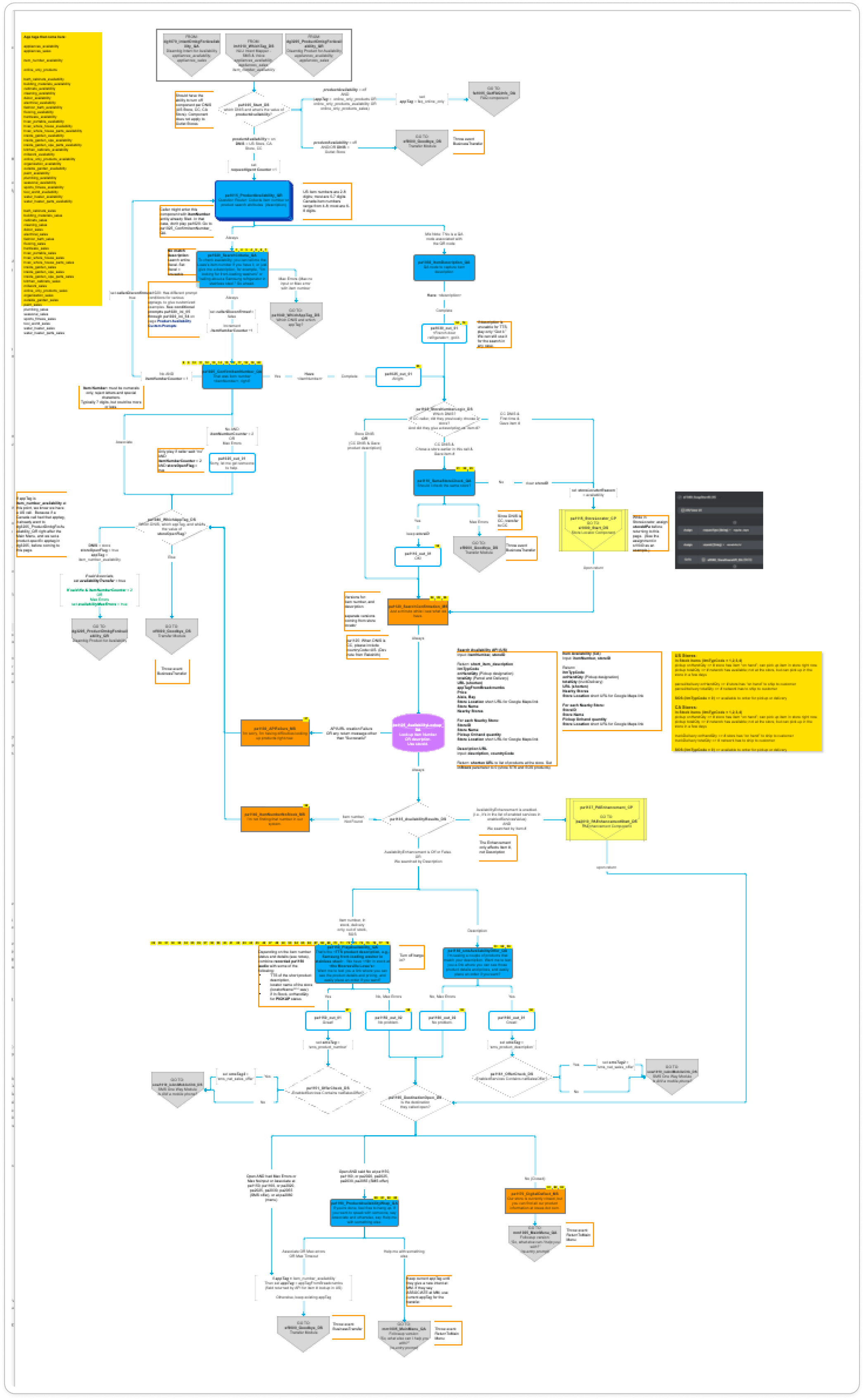
Image blurred to protect data
Testing
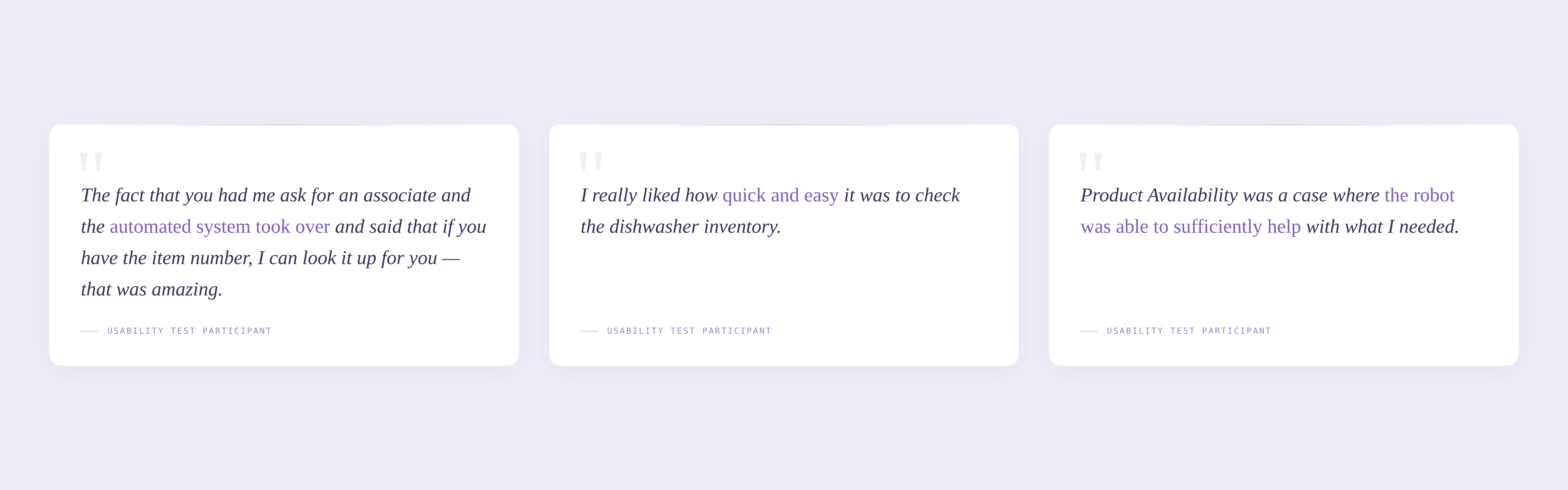
I prototyped the design, and using UserTesting.com, I gathered feedback from 8 random participants who had both shopped at and called Lowe's several times within the past year. All of the participants could complete the task and only one of them had minor struggles due to prototype issues. Overall, the experience was positively received and several of the participants wanted even more capabilities from our system, such as placing an item on hold.
The Implementation
Our developer team took the designs and built them in our staging environment. After copious amounts of testing, they launched the new experience to a few pilot stores. We monitored the data and after seeing customers successfully engage with the experience in the pilot stores, we rolled out the experience to all stores.
Further Refinement & Improvements
While reviewing the call logs, we noticed that even though customers heard that products were in stock, some of them weren't trusting the system completely. To increase their confidence, we updated the design to provide product price and location info, as well as nearby store availability. Additionally, we bolstered our language model with more product synonyms to improve our recognition.
These efforts increased our success rate because we were better at meeting our customers' needs. Each iteration was a writing decision as much as a design one, choosing words that gave customers confidence to trust our system.
Note: This project began in 2022 and has since evolved. As the underlying technology moved from NLU-based to Agentic AI, I stepped into the lead designer role, overseeing other designers' work and ensuring the new system kept the same clear, consistent voice customers had come to rely on.